UK Democracy Bulletin, April 2026
Issue #79 — April 2025
Monthly news, jobs, grants and gossip from across the democracy sector, brought to you by the UK Democracy Network. Read by 450+ UK democracy organisations. We read everyone’s newsletters & research so you don’t have to. If you want us to cover yours, let us know: james@democracynetwork.org.uk
How you can get involved right now! Do these things 👇
- Join the Democracy Network
- See the latest democracy jobs & add your own
- Check available democracy funding
- Explore the Democracy Map
- Subscribe to the UK Democracy Forum Mailing List
Highlights
- Rycroft Review major new review makes key recommendations
- Unlock table prisoner voting extension amendment
- Together Alliance largest anti-racist march in British history
- Women’s Representation three key amendments secured
- Migrant Democracy Project secure new Votes for All amendment
- Unlock Democracy coalition building to advance donations cap amendment
- Netpol concern over erosion of jury equity following legal ruling
#DemocracyJobs
Featured Job Listings across the Democracy Sector. View the full database of upcoming job listings here — have we missed any? Add them via this form.
Rolling deadlines
- Multiple roles: Association of Democratic Services Officers
Featured upcoming roles
- Apply by April 13th: Government & Parliamentary Affairs Officer at Center for Countering Digital Hate (£55,000 — £60,000)
- Apply by April 16th: Product Manager at Electoral Commission (£69,000 — £71,100)
- Apply by 20th April: Community Engagement Manager at Electoral Commission (£52–55k)
- Apply by 20th April: Voter Engagement Support Officer at Electoral Commission (£29–30k)
- Apply by 20th April: Chief Executive at Generation Rent (£68k)
- Apply by May 3rd: User Support Officer at mySociety (£28–30k)
- Apply by May 4th: Chair at Medact (voluntary)
- Apply by May 29th: Research Fellow at The Constitution Society (£8k)
Funding Democracy
London Legal Support Trust celebrate record-breaking 2025 Legal Walk
The London Legal Support Trust has announced that the 2025 London Legal Walk brought together 19,000 walkers for a 10k through the capital, raising £1 million for frontline free legal advice charities and making it the biggest event in the Walk’s 21-year history. A landmark moment for access to justice fundraising in the sector.
David Rockefeller Fund CEO makes the urgent case for longer-term democracy funding
Writing for the National Center for Family Philanthropy, Lourdes Rodríguez, CEO of the David Rockefeller Fund, argues that family and private foundations are uniquely placed to respond quickly to democracy’s needs and should embrace that nimbleness now. She makes the case that democracy funding must go well beyond electoral cycles, covering campaign finance reform, legal costs for civil society and longer grant cycles for pro-democracy organisations. Read the full piece here.
Ford Foundation highlight the power of local “Civic Hubs” in rebuilding rural democracy
A new piece from the Ford Foundation profiles the Trust for Civic Life’s model of investing in locally led “Civic Hubs” — rooted, trusted organisations that bring communities together to solve shared problems and practice democratic skills from the ground up. Charlie Brown, Executive Director of the Trust for Civic Life, argues that national polarisation is best countered at the local level, and that the sector’s challenge is not a lack of ideas but chronic underfunding of community infrastructure.
UK Community Foundations open expressions of interest for Lead the Change youth programme
Lead the Change, a new three-year initiative supporting young people to strengthen relationships, foster understanding and build belonging in their communities, is now open for expressions of interest. The programme is funded by a partnership of major foundations including BBC Children in Need, Co-op Foundation, Esmée Fairbairn Foundation and The National Lottery Community Fund, and will be delivered locally by 17 community foundations across the UK. Grants will be limited to one or two per eligible place. Find out more about eligibility and how to apply at ukcommunityfoundations.org.
Election News
Electoral Commission registration campaign in full swing
The Electoral Commission is urging voters to register before the deadline at 11.59pm on Monday 20th April. For full details on the voter registration deadline see the EC’s media breakdown. The Electoral Commission are still looking for a Product Manager to deliver key digital projects for the Commission through this exciting period and into the future — apply now.
Democracy Club to host UK election data evening in London
Every year Democracy Club hosts SOPN Day, a massive effort by Democracy Club volunteers to collect and upload all the data on the year’s election candidates published on April 9th via the Statement of Persons Nominated. This year Democracy Club is running an event at Newspeak House in East London, an opportunity to contribute to the effort and meet the people that make it all possible — register now for today’s event.
Democracy Club publish full candidate data for Scottish Parliament elections
With Scottish Parliamentary elections on 7th May, Democracy Club has added all candidates to its open database, allowing voters to preview their ballot paper by entering their postcode. 437 candidates from 18 parties are contesting constituency seats, with a further 589 candidates from 27 parties standing on the regional lists. Browse the candidates at candidates.democracyclub.org.uk.
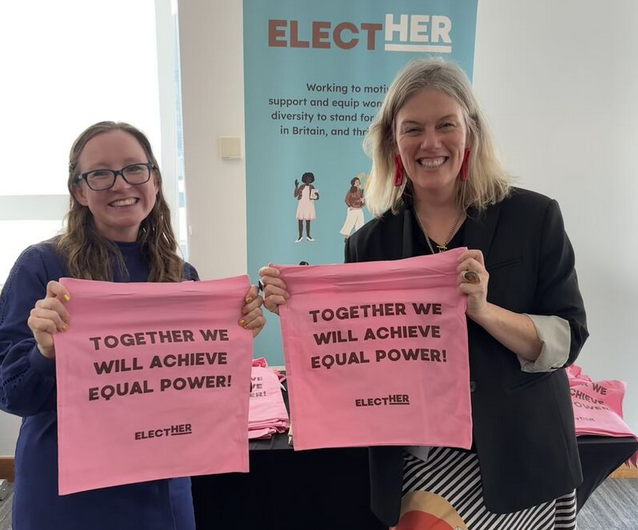
ElectHer is running fortnightly clinics ahead of local elections
ElectHer is running bi-monthly sessions to help female candidates that are running to become local councillors in May. Candidate clinics and Ask Her sessions will be available online and there are plenty more resources on their training platform to help prospective candidates. But that’s not all — this year Elect Her have also provided resources for non-candidates to get involved too, through three new toolkits, check them out now and share among your networks.
My Life My Say host Give an X Live in Hackney ahead of May elections
My Life My Say and Lime are transforming St John at Hackney Church in London into a youth democracy event on 17th April, featuring a Democracy Café, face-to-face time with decision makers and free food. The event is part of Give an X, the youth voter registration campaign calling on young people to get on the electoral roll before the 20th April deadline. Entry is free. Register now.
Coventry City Council Elections Team share inclusive voter engagement work ahead of May local elections
The team at Coventry City Council’s Elections Team has been running a range of targeted voter engagement initiatives ahead of the May local elections, including anonymous registration support for survivors of domestic abuse, outreach to first-time voters, and — after significant GDPR groundwork — direct contact with voters on the sight loss register. The team is also piloting Voting Passports to help voters with disabilities access support at the polls.
Martyn Harris at the Elections Team is keen to connect with anyone who has expertise in GIS or data mining for non-specialists, particularly around updating the electoral register using multiple data sources — please get in touch via martyn.harris@coventry.gov.uk.
London Decides — New London election analysis insights site launches
Lowick Hedry in partnership with OnLondon and election expert Lewis Baston and Dave Hill, the new election guide goes borough by borough through all 32 London councils ahead of May’s local elections. With Labour, the Conservatives, the Liberal Democrats, the Greens, Reform and independents all in play across the capital, the guide covers every candidate, every contest and every significant shift since 2022. It launches on 20th April. Sign up at londondecides.lowickhedry.com to receive it straight to your inbox.

Novara Media and Bureau of Investigative Journalism expose AI character used in far-right political campaigning
A joint investigation by Novara Media and The Bureau of Investigative Journalism has uncovered links between ‘Danny Bones’ — an AI-generated rapper with nearly three million short-form video views — and Advance UK, a far-right party led by former Reform UK co-deputy leader Ben Habib. Experts describe it as the first known case of an AI character being linked to a political party, with the character used to make interventions in February’s Gorton and Denton by-election. Shout Out UK’s Matteo Bergamini warned that such tactics will “continue to grow in regularity as we get closer to the next general election.” The Electoral Commission said it expects AI-generated campaign material to be clearly labelled. Read the full investigation here.
Upcoming Legislation
Working on the Representation of the People Bill? Join the Elections Bill Hub
Kyle Taylor of Fair Vote UK and a range of organisations are working together to coordinate around the bill. If you’re working on the bill, contact Kyle to get involved.
Migrant Democracy Project take Votes for All campaign to Parliament with mass lobby
NC29 — an amendment to extend voting rights to all UK residents has been tabled by Manuela Perteghella MP, supported by the Migrant Democracy Project. The move comes alongside growing concern about the potential threat to Commonwealth citizens’ existing voting rights, with MDP featured in a Guardian briefing on the issue. Read the amendment here. MDP are boosting the campaign and calling on their supporters to join them for a mass lobby in Parliament. To find out more or get involved, contact Lara Parizotto at lara@migrantdemos.org.uk.
Elect Her and allies secure three amendments to Representation of the People Bill
Elect Her’s Annabel Mullin reports they have been working across the women’s sector to push for changes to the Representation of the People Bill, and three of their six proposed amendments are now tabled in Parliament. The amendments span a range of measures to improve women’s political representation, and the organisation is continuing to build support for all six. The amendments represent a joint effort by partners across civil society to bring these amendments, including Centenary Action, The Electoral Reform Society, The Jo Cox Foundation, 50:50 Parliament, The Online Safety Act Network and The Fawcett Society.
Transparency International, Unlock Democracy, Spotlight on Corruption and UKACC to push donation cap amendment
A coalition of organisations are mobilising — including Transparency International, Spotlight on Corruption, Unlock Democracy and the UK Anti-Corruption Coalition — around an amendment to introduce a cap on political donations. Work is ongoing to align the coalition ahead of what promises to be a significant push. Watch this space and if your organisation wants to get involved, contact Tom Brake at tom.brake@unlockdemocracy.org.uk.
Unlock publish report on prisoner voting and secure tabling of franchise extension amendment
Unlock’s new report, Why Prisoner Voting Matters, sets out how the UK’s current prisoner voting arrangements damage both democracy and rehabilitation prospects. The report finds that 21,000 people in prison in England and Wales struggle to access their existing right to vote — let alone those excluded from it entirely. An amendment — NC9 — has now been tabled to extend the franchise to those serving sentences of four years or less. Read the full report here.
Glasgow researchers warn immigration reforms will exclude a generation from civic rights
Researchers at the Glasgow Refugee, Asylum and Migration Network (GRAMNet) published a new analysis warning of long term structural exclusion of asylum seekers and refugees from civic life due to new changes doubling the qualifying period for Indefinite Leave to Remain, a status which serves as a gateway to naturalisation and, with it, the right to vote, stand for office and participate fully in democratic life. Read openDemocracy for the full analysis.
Democracy Sector 🗳️
Rycroft Review published on foreign financial interference in UK politics, as sector calls for government to go further
The UK Government has published the independent Rycroft Review, commissioned to examine foreign financial influence and interference in UK democracy, and has accepted recommendations to cap political donations from overseas electors at £100,000 a year and ban cryptocurrency donations. The review, led by former Permanent Secretary Philip Rycroft, identifies unlimited donations from UK voters living abroad as a clear vulnerability for foreign money to enter the political system and makes 17 recommendations in total, including new investigative powers for the Electoral Commission.
Civil society has welcomed the report but pushed back on the government’s narrow initial response. Dr Susan Hawley, Executive Director of Spotlight on Corruption, said the review “should be a line in the sand for UK politics” but warned that applying the donation cap only to overseas electors leaves a critical loophole open. Duncan Hames, Director of Policy at Transparency International UK, echoed this, arguing that a meaningful cap on all donations is “the most robust safeguard against both foreign interference and the outsized influence of big money in our politics.” The government has committed to responding to the remaining recommendations ahead of the Commons report stage of the Representation of the People Bill.
Together Alliance leads largest ever anti-far-right march through central London
Hundreds of thousands of people marched through central London on 28 March in what organisers called the biggest anti-fascist demonstration in British history. The Together Alliance, backed by around 500 groups including trade unions, antiracism organisations and civil society bodies, converged on Whitehall near the Houses of Parliament. Kevin Courtney, Chairman of the Together Alliance, told the crowd the march “gives us all confidence to carry on.” Amnesty International UK hailed the event as a “historic demonstration” by people calling for a society built on “dignity, compassion and human rights”.
Democracy Drinks Edinburgh coming up
Involve’s Kelly McBride and Paul Hirmis are running regular democracy drinks events in Edinburgh, their next event is an election special on 7th May — sign up now. Contact Involve for more information.
Politics in Action celebrate Votes at 16 announcement after year-long youth-led campaign in Northern Ireland
Politics in Action have been coordinating a youth-led campaign for Votes at 16 since April 2024, with over 40 young people from across Northern Ireland meeting politicians, academics and policymakers and collaborating with Democracy Classroom on a cross-sector vision for implementation. In July, nine young campaigners travelled to London for a series of events organised by The Politics Project, culminating in the launch of the Roadmap to Votes at 16 in Parliament alongside Minister for Democracy Rushanara Ali MP — the day before the Government announced that 16 and 17-year-olds will be given the right to vote in all UK elections. Queen’s University Belfast filmed the trip, and their short film is well worth a watch.
With the franchise win secured, Politics in Action are now turning their attention to civic education, pressing the Department for Education in Northern Ireland and Minister Paul Givan to embed high-quality political education in the Northern Ireland Curriculum — watch the film here and follow their next steps at politicsinaction.org.
Public Law Project hosting intensive judicial review training in London on 19 May
The Public Law Project, in partnership with Blackstone Chambers and Linklaters, is running a full-day in-person training on the fundamentals of judicial review, covering grounds for challenge, procedural steps, funding, costs and third-party interventions. The course is aimed at lawyers, NGO staff, campaigners with a legal strategy, and advisers working with marginalised groups. Tickets range from £75 for non-qualified advisers to £175 for private practice, with a discounted rate of £125 for charities and voluntary sector organisations. Register by 19 May.
Working in Wales? Join Democracy Group Cymru
Democracy Group Cymru is an information sharing network among organisations working in Wales, convened by Democracy Classroom and the Electoral Reform Society Cymru. So if you’re working on democracy in Wales, don’t miss out on opportunities to share your work, connect with others and collaborate — Join now.
Unlock Democracy celebrate campaign success as Electoral Commission independence set to be restored
The independence of the Electoral Commission is to be restored, following sustained campaigning by Unlock Democracy, Electoral Reform Society and allies. The Electoral Commission’s independence was curtailed under the 2022 Elections Act — a move widely opposed by civil society organisations at the time — making this a notable reversal. Tom Brake at Unlock Democracy has more detail — get in touch at tom.brake@unlockdemocracy.org.uk.
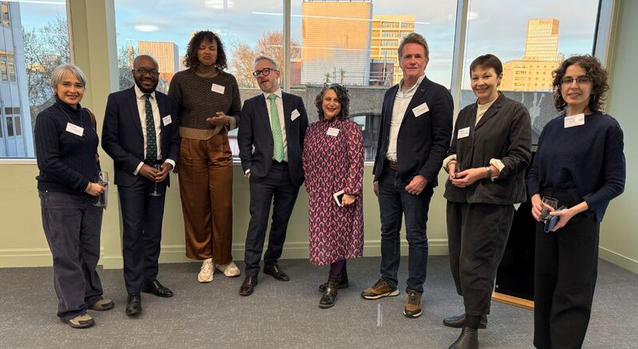
Verdant Thinking launch new think-tank with public participation at its core
Verdant Thinking, a new think-tank co-directed by Deborah Doane and James Meadway, launched this week with an explicit commitment to shaping its policy work through public participation from the outset. The organisation aims for small-scale, high-quality, issue-focused engagement that starts early in policy development, is iterative and genuinely inclusive — and that builds lasting relationships rather than extracting views. Their first participation-informed report is already out, advocating for a ‘Doge of the left’.
Newspeak House open applications to their year-long fellowship programme
Newspeak House runs a political technology and social change residential fellowship out of their London campus and community space. Aimed at supporting mid-career technologists, the one-year programme, Introduction to Political Technology, has been running since 2015 — through which participants spend a year immersed in communities of practice — ranging from government, activism, journalism, charities and beyond — enjoying the opportunity to meet thousands of people and participate in a wide range of in-person events at Newspeak House and elsewhere — find out more and apply.
Netpol explore the state of jury equity after landmark Court of Appeal ruling
The Network for Police Monitoring (Netpol) has published a new explainer on jury equity, the centuries-old principle that allows jurors to acquit according to conscience rather than the strict letter of the law. The piece comes after the Court of Appeal ruled in January on cases involving climate and pro-Palestine protesters. The campaign group Defend Our Juries has warned the ruling is part of a broader effort to curtail juries’ ability to acquit members of social movements. Read the full piece at netpol.org.
Our House invite sector organisations to Chartist mobilising days in Nottingham and Cardiff
Our House are running two upcoming mobilising days as part of their People’s Charter campaign, bringing together those who want to build a better democratic settlement. The Nottingham event takes place on Saturday 11th April (11am–4pm) and the Cardiff event on Friday 24th April (1–5pm). Our House also just completed a new hiring process for two new members of the campaign, congratulations to the lucky new starters!
Advocacy Academy’s Calum Green asks what makes a good organiser?
With the Advocacy Academy moving to a national footing and hiring new organising roles soon, Calum Green has published a practical framework built around four qualities of organising: curiosity about people, a clear understanding of power, focus on winning real change, and comfort with ambiguity. For youth organising in particular, he argues, supporting young people to discover their leadership potential matters more than identifying leadership that is already there.
Act Build Change running online introduction to transformative community organising on 16th April
Act Build Change is hosting a free-to-members online workshop on 16th April introducing participants to transformative community organising, an approach that combines strategic power-building with collective care. The session covers the fundamentals of what organisers do, how to build teams and movements, and how to sustain that work over the long term. Free for Act Build Change members; £15 for everyone else.
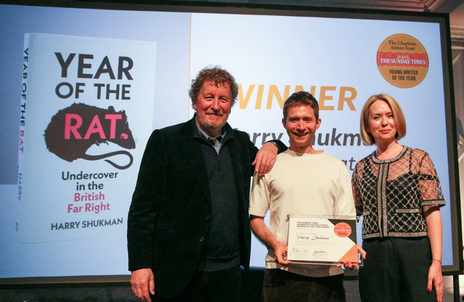
Hope Not Hate’s Harry Shukman wins Young Writer of the Year Award
Harry Shukman from Hope Not Hate put his life on hold to go undercover and expose the far-right in his new book — Year of the Rat. Rubbing shoulders with powerful elites pushing race science as well as the likes of Britain First, Harry spent a year inside far-right networks undercover risking his safety to expose how these groups organise, recruit and normalise extremist ideas. Harry has won the Sunday Times Young Writer of the Year Award for his book Year of the Rat.
Books galore this month: Shout Out UK to publish new book, Man Enough
Shout Out UK work on the front lines in schools, working to equip young people with the media literacy tools they need to navigate a fractured digital world. Their new book — Man Enough — published by Souvenir Press, brings together their experience working in this space, and provides parents with a practical roadmap to help parents equip their sons against toxic ‘manfluencer’ culture. The book releases in September 2026.
Democracy Matters’ Titus Alexander explores how universities can rebuild democratic culture
Titus Alexander of Democracy Matters is calling on political scientists and higher education institutions to take a more active role in strengthening democracy. His work argues for politics as social experiment, tracing democratic models from local to global scale. Titus is also working on a new edition of his 1996 book 7 Pillars of Global Apartheid, updated for the current moment. Those interested in the intersection of higher education, polarisation and democratic renewal are encouraged to get in touch directly at titusa03@gmail.com.
Thinking Box launch six-week online course tackling disinformation, division and democracy
Thinking Box are running a practical, collaborative course exploring the disinformation crisis and its impact on democratic life. Beyond the Noise runs on Tuesday evenings (7–8.30pm) from 14th April to 19th May. Find out more and apply at thinkingbox.info/beyond-the-noise.
James Sherwin-Smith launches campaign to put member democracy back on the ballot at Nationwide
With 16 million members but only 4% voting annually, Nationwide Building Society is not, its critics argue, living up to its mutual principles. James Sherwin-Smith has submitted 350 member nominations to stand on the ballot for the first time in 21 years. His campaign has secured repeated The Times coverage, and he is also working with ShareAction, the Building Societies Members Association and others to push back against government signals that would allow virtual-only AGMs, a move many in the sector see as a step backwards for member participation. James is keen to connect with others interested in the democratic governance of mutuals and cooperatives — get in touch at james@james4nationwide.co.uk or visit james4nationwide.co.uk.
Schumacher Institute launch six-part online series on the politics of transition
The Schumacher Institute is running a series of six linked online talks exploring the systemic barriers to societal transition, led by Schumacher Fellows Jenneth Parker, Ingrid Stjernquist and Kristin Vala Ragnarsdottir. The opening session on 9th April (4–6pm) focuses squarely on democracy — examining stranded assets and the hollowing out of democratic institutions in the context of sustainability. Register for the Zoom link via info@schumacherinstitute.org.uk.
Zero Hour builds nationwide campaigner network to drive constituency action on climate
Campaigning for a citizens’ assembly on climate and nature and the Climate and Nature Bill, Zero Hour has connected over 2,000 campaigners across the UK through constituency WhatsApp groups, coordinating direct MP meetings, with more than 200 meetings delivered so far. The groups are now being used to organise screenings of the newly launching National Emergency Briefing film and campaign. Contact Allan Gray at allangray@zerohour.uk to get involved.
Climate Emergency UK report finds councils with higher spending power deliver better climate action
A new report from Climate Emergency UK reveals a clear link between local authority funding and climate performance: among single-tier and county councils in England, every £200 per capita increase in spending power is associated with a 0.8% improvement in their Action Scorecard rating. Public appetite for climate action matters too — a one percentage point rise in local support is linked to a 1.9 percentage point improvement in Scorecard performance. The findings add weight to calls for greater local government funding as a lever for meeting climate commitments. Read the full report here.
Democratic Reform & Innovation 💡
Nets4Dem invite sector to high-level conference on democratic resilience in Brussels
The Nets4Dem network have invited UK democracy organisations to join them for their upcoming conference Local Action, European Impact: Strengthening Democratic Resilience in Brussels on 5th May, bringing together EU institutions, local government, civil society and researchers to explore how democratic resilience can be built from the ground up. The conference closes with the Nets4Dem Democratic Innovations Awards ceremony — Register now.
Greater Manchester Combined Authority use citizens’ assembly model to reshape Live Well governance
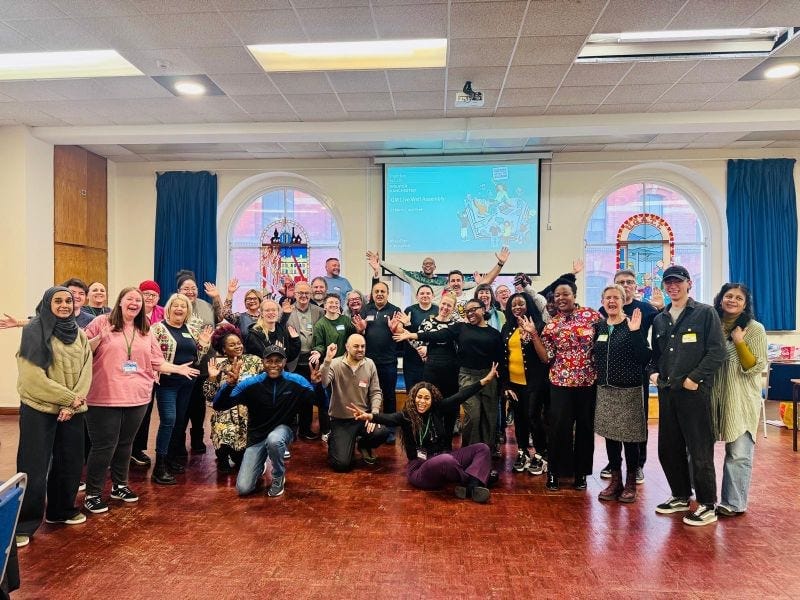
The GM Live Well Assembly, which took place 23–25 March, brought together a diverse group randomly selected to reflect the demographics of Greater Manchester to deliberate on how decision-making and resources can shift closer to communities. Steff Riches, GMCA Participation and Insights Manager, described the experience as “pure joy,” reflecting that bringing people together consistently reaffirms that communities are “kind, caring, able to make space” and ready to take responsibility. Recommendations and next steps are expected to be published in the coming weeks.
International Centre for Sustainability make the case for deliberative technology in UK democratic renewal
A new briefing paper from Dr Pravar Petkar at the International Centre for Sustainability argues that tools like Pol.is, Decidim and ReMesh can scale participatory and deliberative processes at lower cost than in-person assemblies, making them especially relevant at a time of pressure on public resources. The question, the paper contends, is no longer whether deliberative democracy has value but how to embed it practically and inclusively. Read the paper now or get in touch at pravar@icfs.org.uk.
Talk Shop run world’s first Agree-athon, bringing party leaders together to find common ground
Perry Walker at Talk Shop convened the leaders and chairs of five parties in Hereford last month for what is believed to be the world’s first ‘Agree-a-thon’, in which each participant proposed a contentious idea and then had to win agreement from the others. The format surfaces common ground by encouraging politicians to separate the rationale behind a policy from the policy itself. Talk Shop are now looking for collaborators to run future Agree-a-thons and partners to test new Win-Win Workouts on AI and inequality. Get in touch at perryw@talkshopuk.org.
Labour for a New Democracy report growing momentum for PR
A wave of Labour MPs have spoken out in favour of Proportional Representation over recent months, with contributions in LabourList, PoliticsHome, Politics.co.uk and Progress. Meanwhile, Anna Dixon MP has asked ministers to consider establishing a National Commission on Electoral Reform, whilst others spoke directly in the Commons chamber during the Second Reading of the Representation of the People Bill.
First Past The Post ‘creaking at the seams’ says Institute for Government
Hannah White, CEO of the Institute for Government argues that the Gorton & Denton by-election shows FPTP is ‘creaking at the seams’ and argues the importance of adapting the UK’s democratic system to a multiparty future. More than 50 academics and constitutional experts echoed the sentiment in recent weeks, warning that FPTP is not fit for multi-party politics.
DemocracyNext explore how young people’s citizens’ assemblies are reshaping democratic participation
In a new conversation hosted by DemocracyNext, CEO and Founder Claudia Chwalisz speaks with young citizens’ assembly alumni and child rights specialists about what happens when children and young people are given genuine power in democratic decision-making. Watch here.
Democracy Narratives Alliance publish landmark research brief on how to talk about democracy
The Democracy Narratives Alliance, a coalition of more than 35 organisations, researchers and funders, has published a major research brief synthesising evidence from nearly 400 publications on how narratives shape democratic engagement. The brief finds that while large majorities globally say they believe in democracy, record numbers feel it does not work for them, creating space for authoritarian and populist narratives to fill. It maps five dominant narrative types and offers practical guidance on values, framing, audience and messenger, concluding that coordinated, strategic narrative work is not an afterthought for democracy’s defenders but a necessity.
Integrity & Transparency 📣
European Parliament approves EU’s first-ever anti-corruption law
The European Parliament has passed the Anti-Corruption Directive, establishing binding minimum definitions for nine criminal offences — including bribery, embezzlement and abuse of influence — across all member states. The move marks a significant step toward harmonised integrity standards across Europe.
Democracy for Sale reveal government spent over £1 million in legal fees fighting Freedom of Information requests
An investigation by Democracy for Sale has found that Whitehall departments spent more than £1 million on lawyers’ fees fighting Freedom of Information requests at the Information Tribunal in 2024 and 2025. The findings land as anonymously-briefed reports suggest the government may be considering tightening FOI law on national security grounds, with transparency across Whitehall already at its lowest level since records began, departments responding in full to just 29% of FOI requests in 2024. Read the full investigation at Democracy for Sale.

Protest organisers convicted under Public Order Act amid warnings of chilling effect on civil liberties
Chris Nineham, Vice-Chair of Stop the War Coalition, and Ben Jamal, Chair of the Palestinian Solidarity Campaign, were convicted at Westminster Magistrates’ Court last week, accused of inciting protesters to breach police-imposed conditions at a 2025 Palestine solidarity march. The case has raised serious concerns over diminishing protest rights. Labour MP John McDonnell said the judgment “stands as an assault on our civil liberties” and the convictions have prompted widespread warnings that prosecuting organisers for ambiguous on-the-day decisions will have a chilling effect on the willingness of civil society groups to lead lawful demonstrations.
Netpol warn that “nobody is coming to save us” on protest rights
The Network for Police Monitoring has published a damning account of a London Assembly session on 28 March, describing it as “quite frankly, an embarrassment,” after most committee members framed demonstrations as a community threat rather than a democratic right. Deputy Mayor for Policing Kaya Comer-Schwartz offered little resistance to the Met’s increasingly draconian approach, NetPol suggested, and denied knowing about Netpol’s campaign demands despite repeated contact. Netpol conclude that resisting the crackdown is now firmly down to campaigners themselves.
OECD find 19-point gap between anti-corruption rules and their implementation across member countries
The OECD’s Anti-Corruption and Integrity Outlook 2026, covering 37 member and 25 partner countries, finds that while governments have strengthened their integrity frameworks, putting those frameworks into practice remains a significant challenge. Across all areas, the average gap between the strength of integrity regulations (63%) and actual implementation (44%) stands at 19 percentage points in OECD countries, with only one in four members tracking the implementation of their own anti-corruption strategies. The report calls for risk-based, results-oriented reform and greater use of digital tools and AI to close the gap.
International Civil Society Centre map civil society responses to the global rise of anti-rights movements
Senior Programme Manager at the International Civil Society Centre Eva Gondor maps how civil society is pushing back against increasingly organised, transnational anti-rights actors reshaping democratic debate through coordinated campaigns, disinformation, and restrictive legislation. Common response strategies include strategic litigation, digital advocacy, narrative work and coalition building, but the mapping finds collective action remains fragmented and reactive. A virtual learning session on narrative change takes place on 15 April.
US juries find Meta and Google liable for platform harms to children, with implications for UK regulation
Twin verdicts in US courts this month found tech giants Meta and Google liable for harms to young users on their platforms. The cases are significant not just for their scale but for their legal strategy: for the first time, a case has succeeded by targeting the architecture of the platforms themselves rather than the content users post on them. The verdicts are significant for the UK Government, which is already consulting on whether to restrict addictive design features such as infinite scroll and autoplay under powers linked to the Online Safety Act. The government has signalled it wants to be in a position to legislate against addictive design “within months” rather than waiting years for new primary legislation. The US rulings provide fresh legal and evidential grounding for advocates pushing Ofcom and ministers to go further, faster.
Pro-Democracy Tech
Catalyst CIC shuts up shop
Catalyst CIC closed in March 2026 after a deliberate process of winding down. Catalyst shifted over its lifetime from a digital capacity-builder to a convener of the UK tech justice movement and chose to close rather than continue in a state of overstretch, citing thin reserves and a conviction that the next phase of this work should be led by grassroots, by-and-for organisations closer to the communities most affected by tech injustice.
In a final reflective piece, the team was candid about the structural barriers they kept hitting: short-term funding cycles, the sector’s bias towards innovation over justice, and the chronic undervaluing of relational infrastructure. Catalyst’s resources, learning and legacy are being stewarded onwards — visit the legacy hub at thecatalyst.org.uk, and sign up for the new Tech Justice Stories newsletter at buttondown.com/byMultitudes.
Keep on top of union news via new tool developed by Newspeak House student
Whathaveunionsdoneforus.uk is a new tool developed by Chris Owen, a current fellowship candidate at the London College of Political Technology. The tool tracks recent union news, wins and updates. For more info, contact Chris.
Charity Digital Skills Report opens 2026 survey on AI adoption and digital skills
Now in its tenth year, the annual survey is the sector’s key barometer of digital and AI adoption across UK charities. It takes 15 minutes, all questions are optional, and there’s a chance to win £300 unrestricted funding for your organisation. Take part here: surveymonkey.com/r/CDSR2026
Want to get involved in supporting election tech efforts this year?
Join the Democracy Club Slack, the home of election technologists and civic tech practitioners working to support voting systems across the UK.
And now for something completely different …
Unhack Democracy analyse the upcoming Hungarian elections
Zsofia Banuta and the team at Unhack Democracy performed a scenario analysis exercise together with Tactical Voting and explored the possible situations that might arise from election day in Hungary. Zsofi discusses the results with the Hungarian Népszava newspaper.
See you next time,
James and the Democracy Network team