UK Democracy Bulletin, May 2026
Issue #80 — May 2026
Monthly news, jobs, grants and gossip from across the democracy sector, brought to you by the UK Democracy Network. Read by 450+ UK democracy organisations. We read everyone’s newsletters & research so you don’t have to. If you want us to cover yours, let us know: james@democracynetwork.org.uk
How you can get involved right now! Do these things 👇
- Join the Democracy Network
- See the latest democracy jobs & add your own
- Check available democracy funding
- Explore the Democracy Map
- Subscribe to the UK Democracy Announcements Mailing List
Highlights
- Crime and Policing Act 2026 receives Royal Assent, despite cross-faith warnings
- 2026 elections run smoothly, observers highlight voter ID and ballot booth issues
- Deliberative Symposium brings together 70 organisations for cross sector working
- Press Freedom UK falls in global rankings
- Candidate abuse worst on record, Jo Cox Foundation finds
- Republic anti-monarchist campaigners march on Buckingham Palace
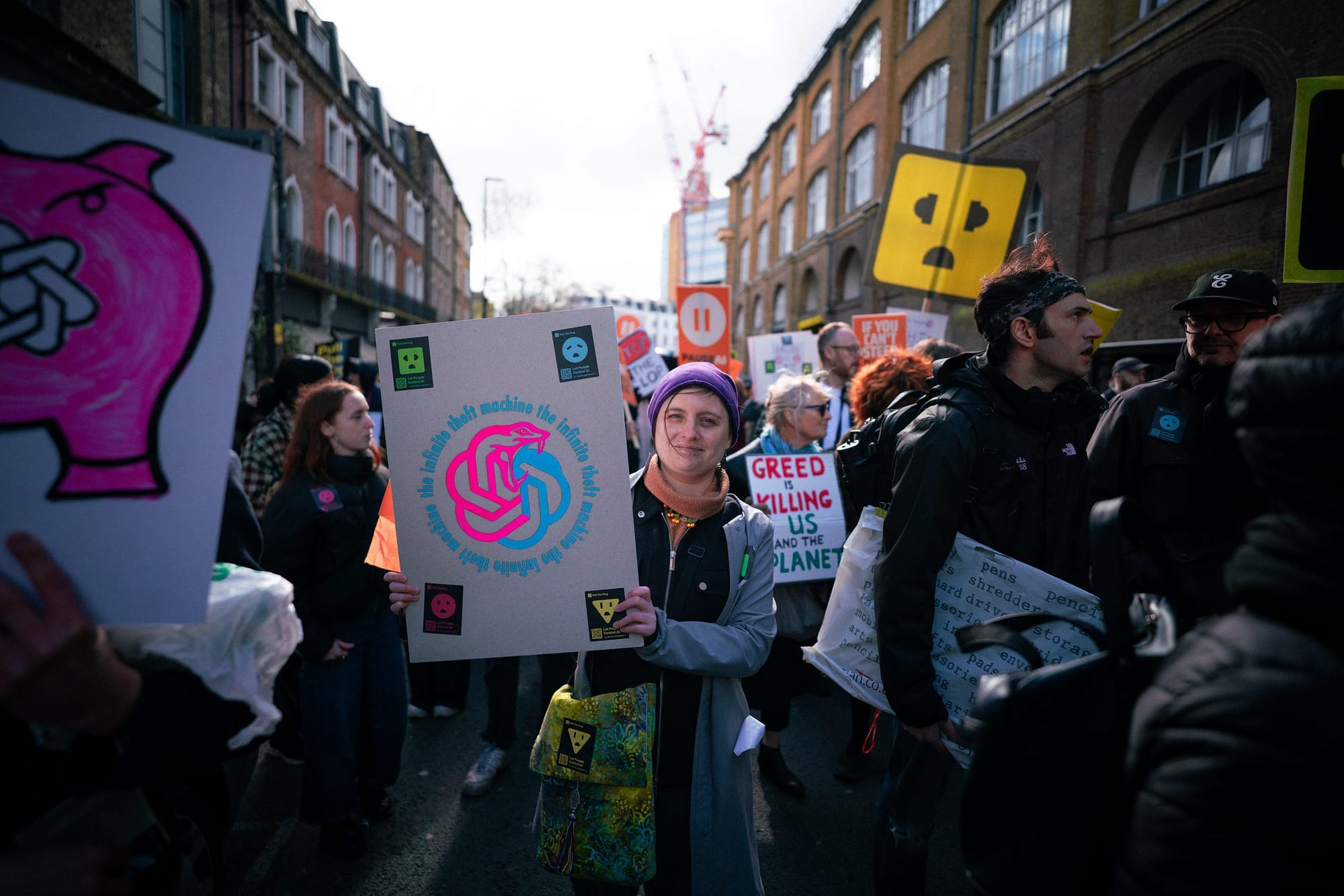
- Pull the Plug new movement makes case for democratic oversight of AI models
#DemocracyJobs
Featured Job Listings across the Democracy Sector. View the full database of upcoming job listings here — have we missed any? Add them via this form.
Rolling deadlines
- Multiple roles: Association of Democratic Services Officers
Featured upcoming roles
- Apply by May 17: Lead Campaigner at We Own It (£40k)
- Apply by May 17–24: Various roles available at Campaign Lab (£30–50k)
- Apply by May 18–31: Various roles available at Advocacy Academy
- Apply by May 18: Regulatory Engagement Manager at Electoral Commission (£52–55k)
- Apply by May 24: Senior Programme & Network Lead at People’s Economy
- Apply by May 25: Data Analyst at More in Common (£37–47k)
- Apply by May 29: Programme Associate at People Powered ($60–74k)
- Apply by May 29th: Research Fellow at The Constitution Society (£8k)
- Apply by May 31: Developer at mySociety (£42–52k)
- Apply by June 1: Policy and Communications Officer at Womens Equality Network Wales (£29–30k)
- Apply by June 4: Head of Digital Communications at Big Brother Watch (£50–60k)
- Apply by June 14: Democracy Network Director at The Politics Project(£60–70k)
Could you lead the Network?
We are hiring a new Network Director to join the Democracy Network team.
We are looking for a new entrepreneurial leader to relaunch and build the next phase of the UK Democracy Network: a national network that helps organisations working to strengthen democracy across the UK connect, collaborate and coordinate more effectively.
This is a rare opportunity to shape a growing national network at a moment of major democratic and political change. The Network already has strong foundations, sector backing, and three years of core funding secured. The next step is building it into an independent, trusted and influential organisation that helps the democracy sector work together more effectively.
Find out more and apply via CharityJobs.
Funding & Grants
New grants awarded, funds opening, and money flowing into the work
UK Community Foundations open expressions of interest for Lead the Change youth programme
Lead the Change, a new three-year initiative supporting young people to strengthen relationships, foster understanding and build belonging in their communities, is now open for expressions of interest. The programme is funded by a partnership of major foundations including BBC Children in Need, Co-op Foundation, Esmée Fairbairn Foundation and The National Lottery Community Fund, and will be delivered locally by 17 community foundations across the UK. Grants will be limited to one or two per eligible place. Find out more about eligibility and how to apply at ukcommunityfoundations.org.
Changing Ideas offer £20,000 to support tenacious campaigners through annual awards scheme, nominations close 15 May
The Tenacious Campaigner Awards, an initiative of Changing Ideas, are offering £20,000 in flexible funding to individual campaigners or small campaign teams, alongside tailored coaching, peer community access, legal and journalistic networks, and wellbeing support. This year the scheme is particularly keen to hear from campaigners holding corporates to account for harm, those working to prevent avoidable deaths, and campaigners based in Scotland. Nominations, which must come from someone familiar with the campaigner’s work rather than the campaigner themselves, closes 15 May 2026. Nominate a campaigner here.
Democracy Re:Boot Camp 2026 opens fully funded applications for young European democracy practitioners, deadline 7 June
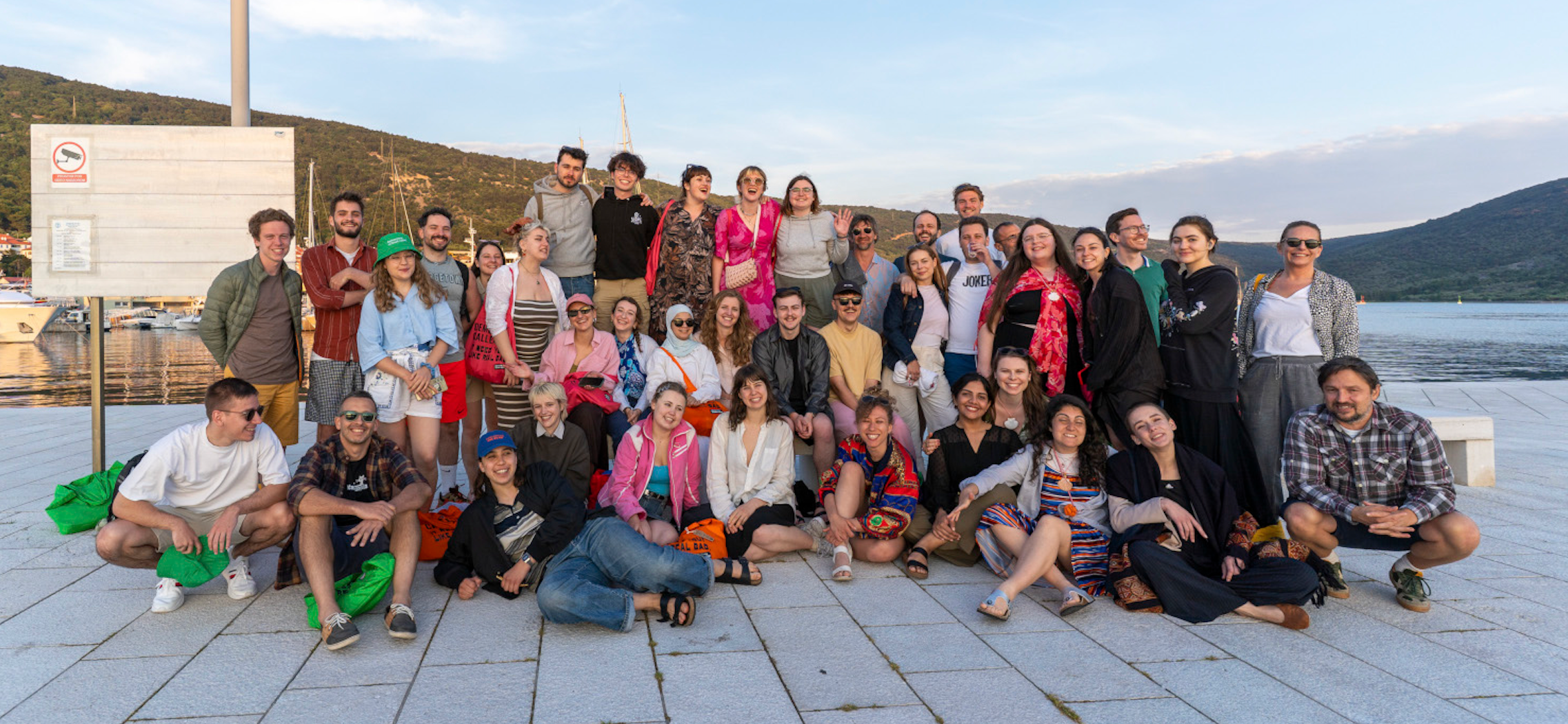
D-Hub’s Democracy Re:Boot Camp returns to the island of Cres, Croatia, 24–28 September, bringing together 30 young people aged 18–28 from across Europe working in organising, journalism, civil society, research or emerging political roles for five days of practical skills, strategic thinking and peer exchange. This year’s edition is anchored around D-Hub’s Anti-Authoritarian Toolkit and is fully funded, covering travel, accommodation and meals. Applications are open to all for the first time and close 7 June. Apply now at democracyreboot.camp.
Events & Convenings
What’s coming up: summits, festivals, training, coworking and gatherings worth turning up to
Regular Democracy Drinks in Edinburgh
Involve’s Kelly McBride and Paul Hirmis are running regular democracy drinks events in Edinburgh, check their Luma events page for the latest. Contact Involve for more information.
Cambridge symposium on protest and peaceful assembly brings together UN Special Rapporteur, Amnesty International and leading scholars
The Centre of Governance and Human Rights at Cambridge yesterday hosted a full-day symposium on the legal, political and practical dimensions of the right to peaceful assembly, featuring Gina Romero, UN Special Rapporteur on the Rights to Freedom of Peaceful Assembly, alongside legal scholars examining how states regulate and restrict protest. The day concluded with an evening panel and book launch for the Oxford Handbook of Peaceful Assembly, which also featured climate activist Roger Hallam. The symposium was timely given the context of the passage of the Crime and Policing Act 2026, which passed into law on 29 April.
Public Law Project hosting intensive judicial review training in London on 19 May
The Public Law Project, in partnership with Blackstone Chambers and Linklaters, is running a full-day in-person training on the fundamentals of judicial review, covering grounds for challenge, procedural steps, funding, costs and third-party interventions. The course is aimed at lawyers, NGO staff, campaigners with a legal strategy, and advisers working with marginalised groups. Tickets range from £75 for non-qualified advisers to £175 for private practice, with a discounted rate of £125 for charities and voluntary sector organisations. Register by 19 May.
Hope for the Future host sessions on the new Senedd and counter-lobbying this May
Hope for the Future is running two sessions to help advocates engage with the new Senedd during its crucial first 100 days. They are also hosting a counter-lobbying workshop exploring how people power and democratic engagement can push back against corporate lobbying. Register for the Senedd evening session on the 26 May, and the counter-lobbying workshop on 21st May.
UCL Policy Lab convene Ecosystem conference, 28 May
The UCL Policy Lab’s Ecosystem Project is hosting a half-day conference on 28 May, 12:30–4:30pm at UCL East in London, bringing together Miatta Fahnbulleh MP, Parliamentary Under-Secretary for Devolution, Faith and Communities, alongside US scholars Hahrie Han and Gary Gerstle and Australian organiser Amanda Tattersall to explore how progressive movements build power in a contested political moment. Join the waitlist here, or register for the evening community celebration on the same day.
Jim Coe and Natasha Adams launch report on NGO responses to far-right authoritarianism, online 20 May
Following their Meeting the Moment paper, consultants Jim Coe and Natasha Adams are launching “Towards Meaningful Action,” exploring why social change NGOs are struggling to respond fully to far-right authoritarianism and how to address that. Join the online launch on Wednesday 20 May, 10–11:30am BST. Register here.
Our House to host new event on Building a Disabled People’s Charter, 9 June
Our House’s June 9th event starts with the a simple basis: any work that claims to speak for disabled people must also include the voices of people with learning disabilities and autistic people. Full stop. That’s why they’re bringing together key voices on Disability rights in the UK, disability rights advocate Martyn Sibley and #MyVoteMyVoice Project Lead Lxx Garcia, together with Mara Livermore, co-lead at Our House to explore the case for a new Disabled People’s Charter. Sign up now!
Migrant Voice host community events across London and Scotland as part of A Million Acts of Hope week
Migrant Voice are hosting two community gatherings this month as part of A Million Acts of Hope week: “Give Hope a Voice” yesterday in London, a community evening of writing, music and dance with emerging migrant writers in partnership with TogetherintheUK, and “Acts of Kindness” on 20 May online for their Glasgow and Scottish community, where participants will share stories of care and connection and co-create a zine. Sign up for their events here.
Roger Macnair and Luke Flegg convene deliberative democracy symposium
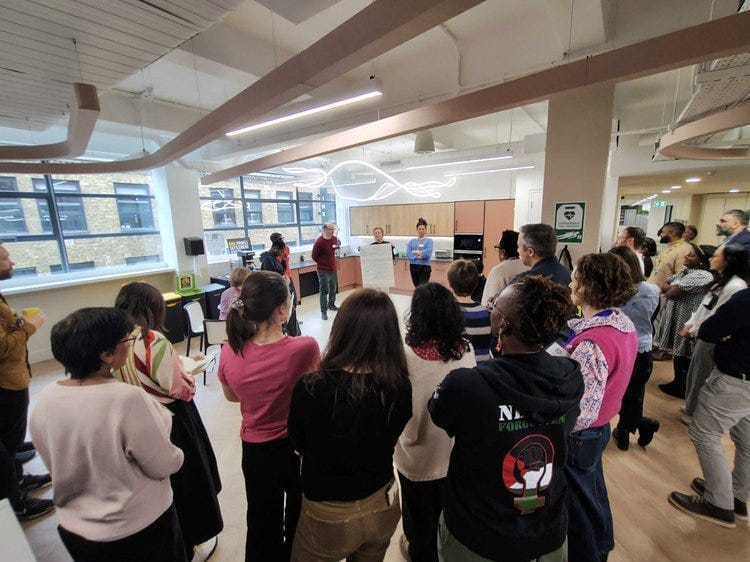
Roger Macnair and Luke Flegg brought together around 70 organisations from across the UK’s deliberative and participatory democracy ecosystem in London last month for a first-of-its-kind gathering designed to help the deliberative sector better understand itself and begin coordinating more effectively. The event saw participants vote on lightning talks, World Café discussion tables and open space breakouts, with participants encouraged to swap contacts and identify concrete next steps for working across organisational silos.
Bureau of Investigative Journalism launches photography exhibition on offshore financial secrecy
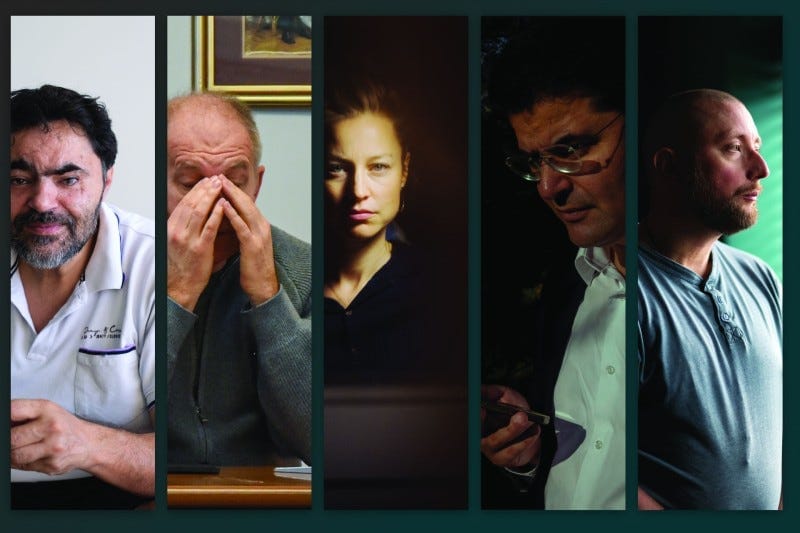
The Bureau of Investigative Journalism has opened Voices for Transparency, a free exhibition putting human faces to the harm caused by hidden ownership in British Overseas Territories and Crown Dependencies. Building on their Enablers project, launched in summer 2020, investigates how the UK and its Crown Dependencies and Overseas Territories enable oligarchs, dictators and criminals around the world. Timed to coincide with the UK’s Illicit Finance Summit in June, the exhibition celebrates the role of investigative journalism. The exhibit runs at The Guild Church of St Katharine Cree in London until 19 May 2026.
Research, Reports & Tools
Fresh thinking, new evidence and practical resources to put to use
Open Rights Group warn of national security risk from UK’s reliance on Big Tech
Open Rights Group have published Tech Giants and Giant Slayers: The Case for Digital Sovereignty and the Digital Commons, the first UK report to make a comprehensive case for a national digital sovereignty strategy. It argues that dependence on a handful of foreign tech corporations for critical digital infrastructure has become an urgent security concern, pointing to the US government’s recent use of tech sanctions against the International Criminal Court, which led Microsoft to shut down email and online banking facilities for ICC members, as a live example of the leverage foreign powers can exert. Jim Killock, Executive Director of Open Rights Group, said the over-reliance on foreign tech companies “is now an urgent national security issue as well as an economic threat”.
AI & Democracy Foundation launch Democratic Capabilities Gap Map for the deliberative democracy field
The AI & Democracy Foundation have published a new open database, the Democratic Capabilities Gap Map, tracking 51 capabilities, 259 research questions, 16 product gaps and 160 resources to identify what it would take to make deliberative democracy ‘truly excellent’ and where the field currently falls short. The resource is designed to help funders, researchers and practitioners direct effort and money toward the gaps that matter most, as enthusiasm and investment in deliberative democracy continues to grow. Explore the map and submit contributions at democracybuild.org.
Carnegie UK find nearly half of MPs believe deliberative democracy undermines their role in new survey of elected members
Carnegie UK have published new research surveying 203 elected members across Westminster, Holyrood, Stormont and the Senedd on their attitudes to deliberative democracy, finding that 45% of MP respondents believe deliberative processes lack democratic mandates and duplicate the role of elected representatives, while only 21% felt Westminster could act upon their findings. Adam Milne, Senior Policy Advocate at Carnegie UK, argues the findings point to a deeper structural problem in which deliberative processes sit outside the normal machinery of government. Carnegie UK’s forthcoming publication “Blueprints for Democratic Wellbeing” will set out how to do this. Read the full piece on LinkedIn.
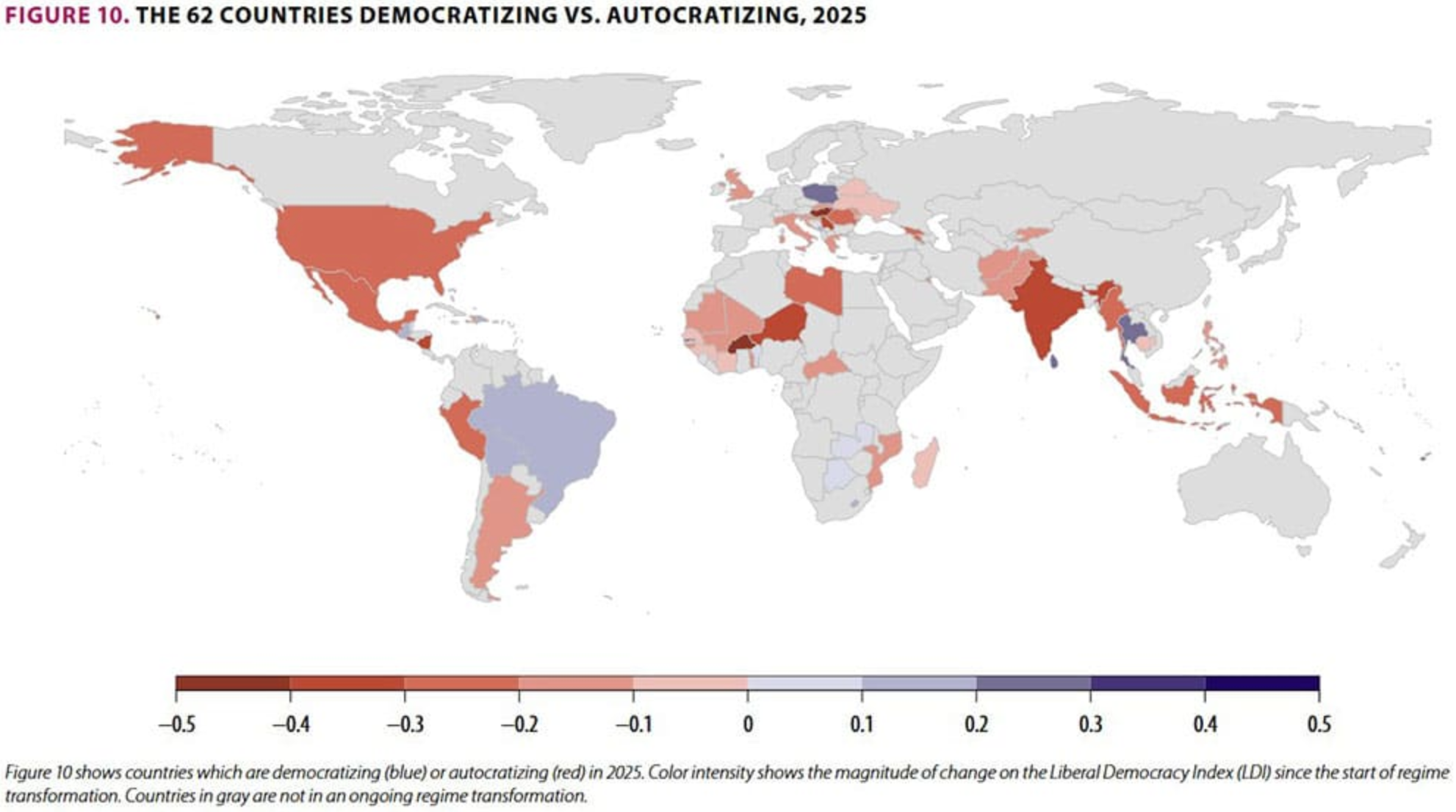
V-Dem Institute names the UK a new autocratiser in its 2026 Democracy Report
The V-Dem Institute at the University of Gothenburg has classified the UK as one of ten newly identified autocratising countries in its annual Democracy Report 2026, placing it alongside Croatia, Italy, Slovakia and Slovenia in a group of five European nations newly added to the watchlist. The report, now in its tenth edition, finds that global democracy has regressed to 1978 levels, with 74% of the world’s population now living in autocracies and media censorship identified as the most common tactic used by backsliding governments. Read the full report.
Reporters Without Borders ranks UK 18th in 2026 World Press Freedom Index amid global low
The UK has placed 18th of 180 countries in Reporters Without Borders’ 2026 World Press Freedom Index, as global press freedom hits a 25-year low. Key UK flags included transnational threats against Iranian journalists in exile in the UK, SLAPPs aimed at gagging reporters, sustained job cuts, mounting pressure on the BBC and a national newspaper market dominated by just three companies: News UK, Reach, and DMGT. Worldwide, more than half of all countries are now classed as “difficult” or “very serious” for journalism, with the legal indicator showing the sharpest fall. Read the UK Press Freedom country profile.
D-HUB launch Anti-Authoritarian Toolkit fight back against democratic backsliding
Democracy Hub (D-HUB) have launched the Anti-Authoritarian Toolkit, compiling tactics and strategies for resisting “elected authoritarianism” and strengthening democracies. The toolkit includes an Authoritarian Playbook naming the patterns deployed by leaders from Trump to Orbán, a Democratic Playbook curating over 50 counter-tactics, a dedicated volume on Get Out the Vote strategies, and a companion podcast series featuring frontline democracy defenders. Nika Kovač, Executive Director of D-HUB, says the goal is to give practitioners “the tools to engage, inspire, and turn people into agents of democracy”. Explore the toolkit at antiauthoritarian.com.
Calls to Action
Consultations to respond to, open letters to sign, convening to follow and collaborators wanted
Working in Wales? Join Democracy Group Cymru
Democracy Group Cymru is an information sharing network among organisations working in Wales, convened by Democracy Classroom and the Electoral Reform Society Cymru. So if you’re working on democracy in Wales, don’t miss out on opportunities to share your work, connect with others and collaborate — Join now.
UK Government opens call for evidence on 7th Open Government National Action Plan
The government is seeking ideas from civil society and the public for its next National Action Plan for Open Government, covering transparency, accountability, open data, digital governance and public participation, with no limit on the number of submissions. Find out more information about you can submit your ideas.
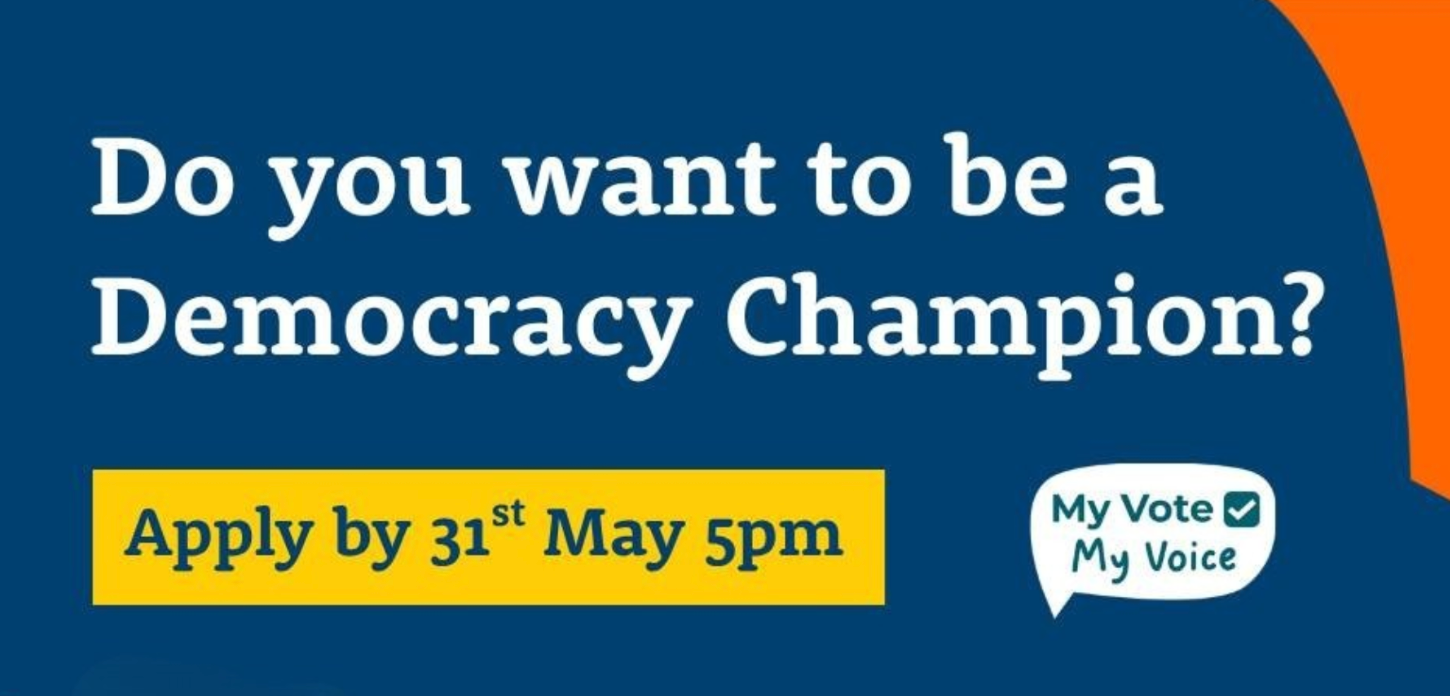
My Vote My Voice recruiting Democracy Champions
My Vote My Voice, the campaign run by United Response, Dimensions, Mencap and Ambitious about Autism, is recruiting its next cohort of Democracy Champions to help people with learning disabilities and autistic people take part in elections. Champions, who can be support workers, volunteers, teachers or community organisers, will receive a half-day training session this summer (in-person or online), a toolkit of guides and activities, a certificate, and a grant for delivering sessions in their communities. Travel and care costs are covered and the programme is funded by the Electoral Commission. Apply by 5pm on 31 May.
Newspeak House open applications to their year-long fellowship programme
Newspeak House runs a political technology and social change residential fellowship out of their London campus and community space. Aimed at supporting mid-career technologists, the one-year programme, Introduction to Political Technology, has been running since 2015 — through which participants spend a year immersed in communities of practice — ranging from government, activism, journalism, charities and beyond — enjoying the opportunity to meet thousands of people and participate in a wide range of in-person events at Newspeak House and elsewhere — find out more and apply.
Election News 🗳️
Updates from the ballot box
Democracy Club publish complete 2026 English local election results dataset covering 18.5 million votes
Democracy Club have completed their post-election data collection and published the full results of the 2026 English local elections, covering 18.5 million votes cast across all candidates, assembled by their volunteer contributor network from nomination papers and count returns. The dataset, which powers WhoCanIVoteFor and is used by the Electoral Commission, the House of Commons Library and national media, is free to download from the candidates database and represents a decade of local election data that Democracy Club has now built. Review and download the full dataset.
Want to get involved in supporting election tech efforts next time? Join the Democracy Club Slack, the home of election technologists and civic tech practitioners working to support voting systems across the UK.
Electoral services teams across the UK complete most complex local elections in years
As the headlines focus on the results of the 7 May local elections, Laura Burrell, Electoral Services Manager at Kirklees Council, has spoken for many in the profession in paying tribute to the electoral administration workforce behind the count. All-out elections following ward boundary changes are among the most complex polls to deliver, and Burrell described her team’s achievement as the product of “months of late nights, weekends and hours together.” A timely reminder that free and fair elections depend on dedicated public servants working largely out of sight.
Who Targets Me find Reform UK’s digital campaign has ‘professionalised’ dramatically since 2024
Election ad-tracking project Who Targets Me have published new analysis showing Reform UK’s online operation has scaled up sharply during the local, Scottish and Welsh election campaigns. Reform’s main Facebook page ran around 40 ad variations during the 2024 general election, but has run roughly 2,300 in the last month alone, briefly outspending Labour on Meta in the week of 21–28 April, they say. The party is also targeting at postcode level for the first time and routing the bulk of spend through the central party page rather than Nigel Farage personally, who is now outspent by the main account by roughly ten to one. Read the full Who Targets Me analysis here.
Jo Cox Foundation warns candidate abuse in May elections worst on record
Candidates across parties describe a climate of abuse during this year’s local and devolved elections, including death threats and intimidation, with the Green party calling 2026 the worst campaign year in memory. Olivia Field, Chief Executive of the Jo Cox Foundation, said: “Increasingly, people do not feel safe enough to fully participate in politics. Some are choosing not to stand at all, while others are self-censoring or limiting how they engage with voters.” The Electoral Commission will publish its full findings on abuse and intimidation from the 2026 elections in the autumn.
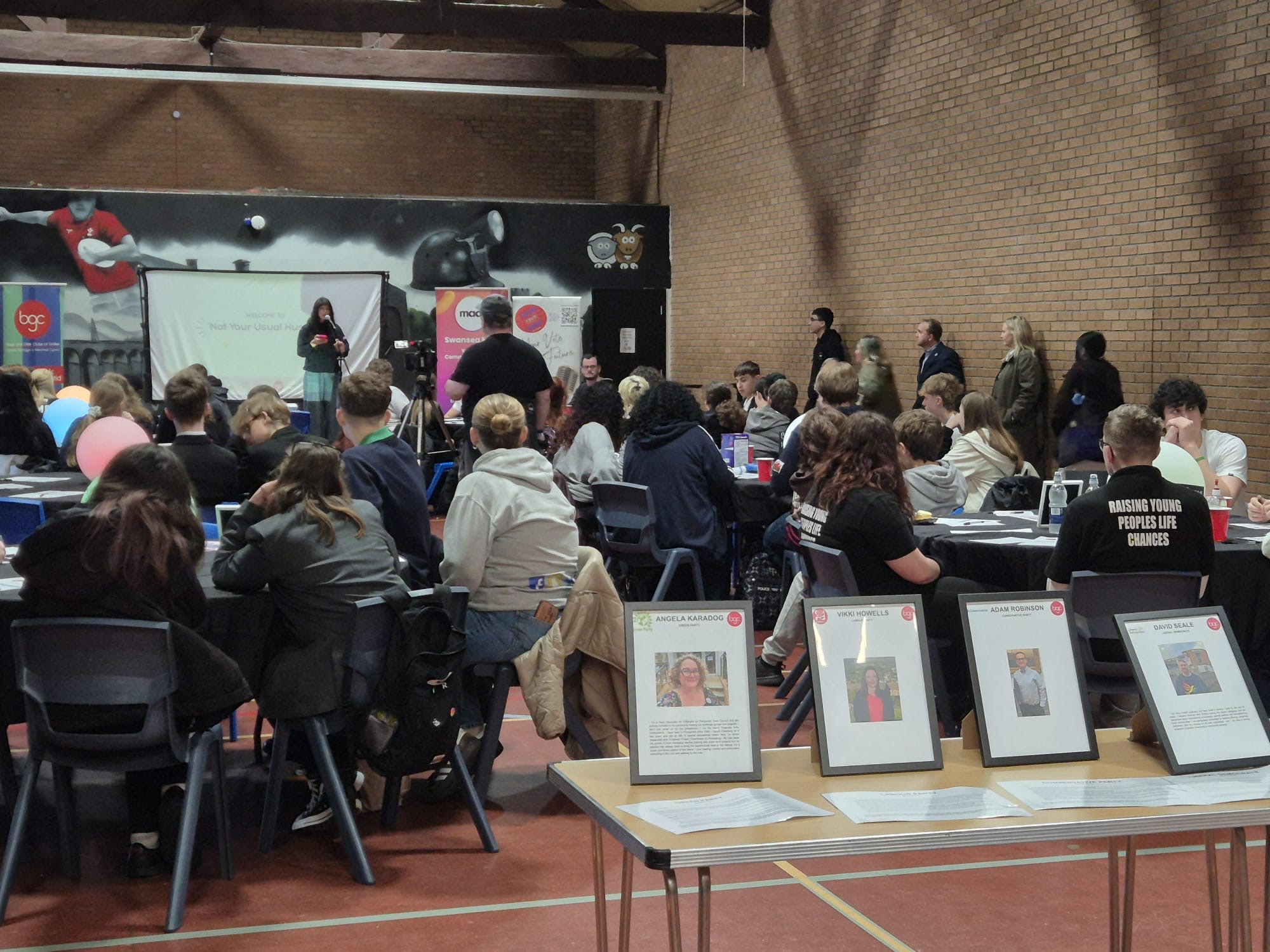
Boys’ and Girls’ Clubs of Wales bring 55 young people face-to-face with Senedd election candidates at youth hustings
Boys’ and Girls’ Clubs of Wales hosted a ‘Not Your Usual Hustings’ at Dowlais Community Centre on 17 April, bringing 55 young people into roundtable discussions with representatives from seven parties ahead of the Senedd elections, in partnership with Swansea MAD and supported by Cavendish Cymru. Funded through the Welsh Government’s Democratic Engagement Grant, the event used a photo booth, mock voting station and informal activities to create an accessible environment for young people from a range of backgrounds, with additional support from Promo Cymru and the Senedd Commission.
Electoral Commission confirm smooth polls but flag voter ID data gap and candidate safety concerns ahead of autumn report
The Electoral Commission described polling day across England, Scotland and Wales as having run smoothly, with more than 17,000 polling places, 25,000 candidates and counts taking place across Great Britain. However, the Commission notes there is currently no legal duty for returning officers in England to collect and report data on the impact of voter ID, meaning the full picture will depend on voluntary local authority disclosure, with the Commission publishing its findings in the autumn.
Council of Europe observers record voters turned away under voter ID rules
The Congress of Local and Regional Authorities of the Council of Europe, conducting its first ever observation mission to the UK, found polling day calm and orderly, with highly committed staff and a high level of trust in electoral processes among voters, candidates and staff. However, observers noted ballot booth layouts were too narrow to guarantee secrecy of the vote, and in England some voters were turned away due to photo ID requirements, while some polling station staff were uncertain about observers’ rights to ask questions. The observers included politicians from Ireland, Poland, Germany and Moldova, such as Jani Kokko, a member of the Finnish parliament and election observer who says, “observation is more important than ever because of the increasing threat posed by foreign interference, attempts to undermine democracy, and disinformation.”
The Politics Project support youth hustings and launch #ElectionCountdown resources ahead of 2026 elections
From Cardiff to Cardigan, The Politics Project’s Host a Hustings Cymru programme, funded by the Welsh Government, helped teachers and youth practitioners organise and deliver their own youth hustings events for the 2026 Senedd elections, providing bilingual resource packs, candidate liaison support and training for young chairs. Their #ElectionCountdown programme, consisting of eight short modules, supported young people across the country to follow elections, register to vote, and learn about candidates and manifestos.
Senedd Explained reach over one million users with volunteer-led 2026 Senedd Election coverage
Senedd Explained, the civic education platform dedicated to making Welsh politics accessible, deployed a team of volunteers to count locations across Wales on results day last week to deliver live on-the-ground analysis and vox pops with candidates from all six parties elected to the Senedd. Maddy Dhesi, Co-Founder at Senedd Explained, reported that the organisation’s April-May election content reached over one million users, with at least half of that figure recorded on results day alone. Follow Senedd Explained for further analysis and coverage still to come.
Widespread tactical voting took place during elections, from Hull to Holyrood
Campaign groups issued tactical voting advice for all but one of the 19 seats contested in Hull, urging voters to back whichever candidate was best placed to beat Reform UK. YouGov research prior to the elections found that 57% of current Green supporters said they would vote tactically for Labour in a direct contest between Labour and Reform, rising to 67% who would switch to the Liberal Democrats in the same scenario. The picture was more complex in Wales, where Nation Cymru and academics from Cardiff University’s Wales Governance Centre noted that the new closed-list proportional system makes traditional tactical voting logic largely redundant.
Democracy Sector 🗳️
The latest moves, hires, partnerships and organisational news from across the democracy sector

ADSO opens nominations for its 2026 Democratic Services Awards
The Association of Democratic Services Officers (ADSO) is inviting nominations for its annual awards, recognising outstanding individuals and teams across the democratic services sector. Categories cover everything from newcomers making an early impact to long-serving professionals who have made a distinguished contribution to local democracy. Nominations close on Friday 22 May, ahead of the ADSO Conference and Awards taking place on 10–11 September. Make your nomination now.
The Advocacy Academy opens recruitment across seven roles in a major hiring push
The Brixton-based youth organising charity, Advocacy Academy, which trains young people with lived experience of injustice to drive long-term systemic change, is recruiting for positions spanning organising, campaigns, programme and operations. Roles on offer include a Community Organiser, Head of Digital Organising & Communications, Head of- and Associate Director of Organising & Campaigns (two posts), Head of Spacemaking and Operations, Head of Programme (mat cover), and Senior Leads for their Gender and Climate Coalitions. Deadlines start 18 May 2026 onwards. Browse the full listings on CharityJob.
Bright Blue launches European affiliate to tackle cross-national policy challenges
Bright Blue, the UK liberal conservative think tank, has established a European arm, Bright Blue Europe, to work on policy issues that require cooperation between multiple national governments, including immigration, populism, energy and democracy. The new outfit is co-founded by Bartek Staniszewski, previously Head of Research at Bright Blue, and Lukas Wick, formerly of the Konrad Adenauer Stiftung, and has affiliates in Germany, Poland, Belgium, the Netherlands, Spain and the UK. A welcome addition for those tracking centre-right thinking on cross-border challenges.
Thinking Box running six-week online course tackling disinformation, division and democracy
Thinking Box are running a practical, collaborative course exploring the disinformation crisis and its impact on democratic life. Beyond the Noise runs on Tuesday evenings (7–8.30pm) and has been running from 14th April and will run to 19th May. Find out more and apply at thinkingbox.info/beyond-the-noise.
Center for Countering Digital Hate hiring a Research Officer
The Center for Countering Digital Hate (CCDH) are recruiting a Research Officer to join their UK team, producing written research on digital hate, misinformation and online harms. Applications close on 18 May — Apply now
Meg Russell to step down as Director of the UCL Constitution Unit
Professor Meg Russell is stepping down as Director of the UCL Constitution Unit, a position she has held since 2015. She will be succeeded by Professor Alan Renwick. Read their latest Constitution Unit Monitor briefing, a quarterly in-depth summary of the latest constitutional matters from across the UK.
Transparency International UK opens membership to new supporters
Transparency International UK hosted a spring reception in central London last week for its growing community of individual members, looking ahead to a year that takes in June’s Illicit Finance Summit in London, renewed efforts on standards in public life, and the case for stronger governance of rising defence spending across Europe. Daniel Bruce, Chief Executive of Transparency International UK, said members “play an important role in our independence and governance, helping to shape our future.” Sign up as a TIUK member today.
Parliamentary Business
Upcoming legislation, parliamentary activity and campaign coordination
Working on the Representation of the People Bill? Join the Elections Bill Hub
Kyle Taylor of Fair Vote UK and a range of organisations are working together to coordinate around the bill. If you’re working on the bill, contact Kyle to get involved.
Unlock Democracy coordinate three campaigns around the Representation of the People Bill and want your help
Unlock Democracy are coordinating across three fronts as the Representation of the People Bill progresses: working with Transparency International, Spotlight on Corruption and UK Anti-Corruption Coalition to secure a donation cap amendment; pushing the government to commit to a timetable for automatic voter registration that ensures it is in place before the next general election; and supporting a campaign to improve the voting system for UK overseas voters so more ballots are received in time to be counted. If your organisation wants to get involved in any of these campaigns, contact Tom Brake, Director at Unlock Democracy, at tom.brake@unlockdemocracy.org.uk.
Fair Vote UK coordinate joint civil society campaign on political finance ahead of Representation of the People Bill third reading
Kyle Taylor at Fair Vote UK is pulling together a coalition campaign, which the organisation is calling “Politics Not For Sale,” to push for stronger donation limits in the Representation of the People Bill before its third reading, after Fair Vote UK argued in a recent briefing that the government’s proposed £1 million donation cap “accommodates” rather than addresses the concentration of financial influence in British politics. Organisations interested in joining the coalition can fill in the campaign form and contact Fleur, Campaign Coordinator at Fair Vote UK, at fleur@fairvote.uk.
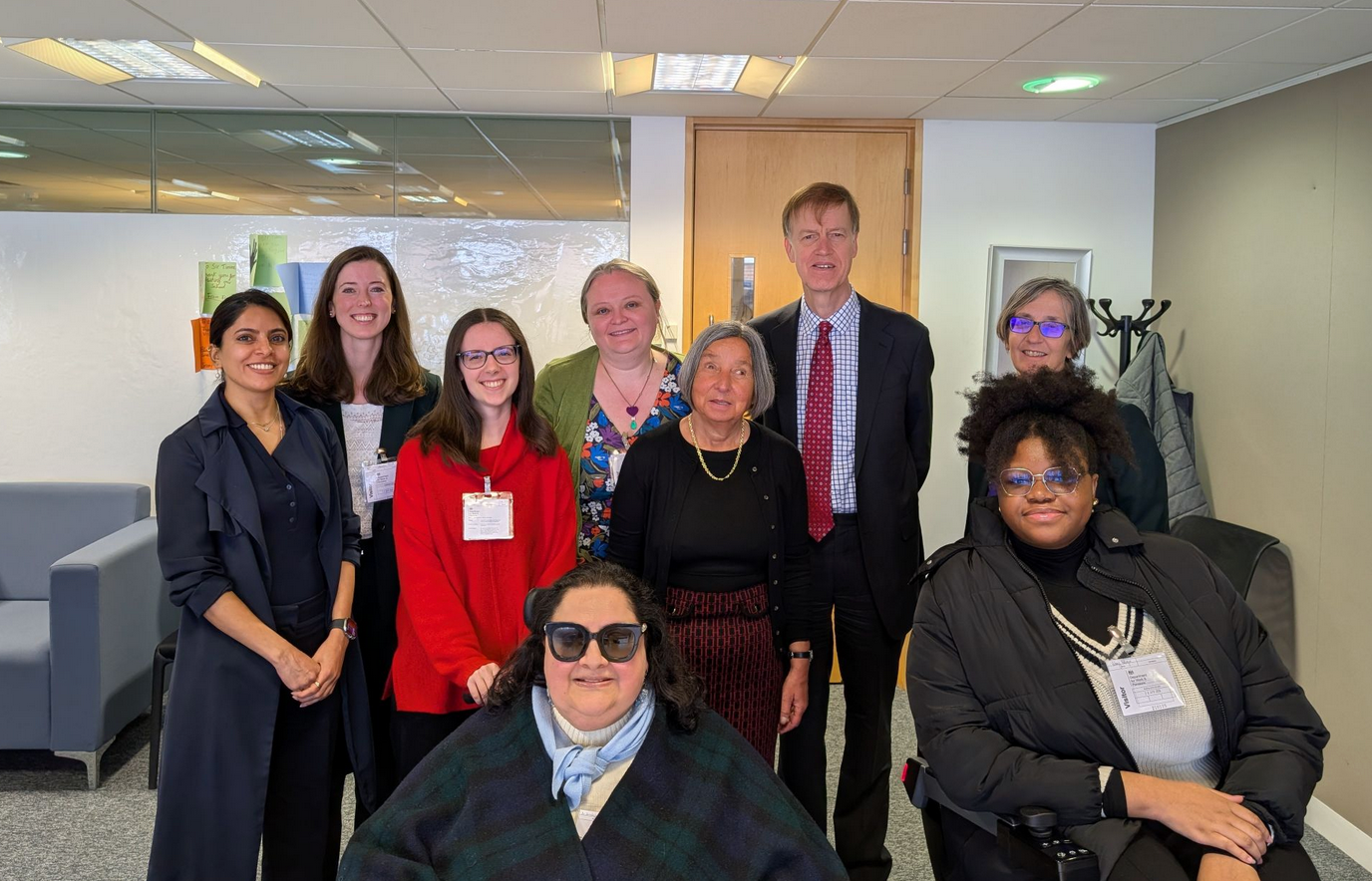
Centenary Action and partners press DWP minister for clear timeline on disabled candidates fund
Centenary Action, Disability Rights UK, Girlguiding and the Disability Policy Centre met Sir Stephen Timms MP, Minister of State for Social Security and Disability, last week to discuss barriers facing disabled women seeking elected office. The minister indicated the government’s new fund for disabled candidates should be in place by the end of the year, ahead of the May 2027 elections, but the coalition pressed for a published timeline and for the fund to be placed on a statutory footing through the Representation of the People Bill. They also called for the long-delayed Section 106 of the Equality Act on candidate diversity data to be commenced.
Labour for a New Democracy say results prove First Past the Post has reached breaking point
Following the May local elections, Labour for a New Democracy have called on the government to urgently establish a National Commission on Electoral Reform, arguing that results across England demonstrated First Past the Post handing majorities to parties on minority vote shares and producing outcomes that are, in the words of Professor Alan Renwick “simply indefensible.” The campaign says a strong caucus of pro-PR Labour MPs is now coordinating through the APPG on Fair Elections and will use the Representation of the People Bill to press for the commission when Parliament returns. Read their full response here.
CWU backs proportional representation at annual conference, taking pro-PR union Labour affiliates to three quarters
The Communication Workers’ Union voted at its annual conference on 10 May to back proportional representation, committing the union to reject First Past the Post, support a form of PR that maintains the constituency link, and call on the government to establish an independent Commission on Electoral Reform. Labour for a New Democracy, which worked with union activists to table a motion to CWU conference back in 2022 that triggered a policy review, reports that trade unions representing three quarters of Labour affiliates now back PR, including Unite, Unison, ASLEF, Usdaw and the FBU.
Open Britain call for donation caps as Electoral Commission weighs formal investigation into Farage’s £5m gift
In 2024, Nigel Farage received a £5 million personal gift from Thailand-based crypto billionaire Christopher Harborne, and did not declare it at the time; the Electoral Commission is now deciding whether to open a formal investigation, and the matter has been separately referred to Parliament’s standards watchdog. Open Britain argue the case illustrates a wider structural failure, noting that Harborne has donated a reported £12 million to Reform UK across 2025 and early 2026, and that the Representation of the People Bill currently passing through Parliament still contains no meaningful cap on political donations. They are calling on the Government to use the Bill to close that gap and limit the scale of individual influence over political parties.
Power & Structure
Where power sits and who gets a seat at the table
Crime and Policing Act 2026 becomes law
The Crime and Policing Act 2026 has passed into law, introducing a new duty on senior police officers to consider the cumulative impact of repeat protests in the same location when deciding whether to impose conditions, meaning peaceful demonstrations could be restricted not on their own merits but because of previous unrelated protests in the same area. The Act, the third piece of anti-protest legislation in recent years, was passed after MPs voted on 532 amendments in a single day, raising serious concerns about the depth of parliamentary scrutiny given the serious implications for civil liberties.
A joint letter coordinated by Quakers in Britain and signed by 19 faith and belief leaders across Christian, Jewish, Muslim, Hindu, Sikh and Buddhist communities had urged MPs to remove the cumulative disruption clause, with Paul Parker, Recording Clerk of Quakers in Britain, warning it creates “an increasingly hostile climate for protesters who seek a better world.” Read the Network Policing project’s explainer and the government’s own factsheet on the new law.
Migrant Democracy Project bring 100+ residents to Parliament in mass lobby for Votes for All
Over 100 residents met with 24 MPs at Parliament on 20 April, organised by Migrant Democracy Project to demand an amendment to the Representation of the People Bill 2026 extending voting rights to all UK residents. Katie, Community Organiser at Migrant Democracy Project, writing in a guest blog for Make Votes Matter last month warned that over 4.4 million people are currently excluded from general elections and over 1.2 million cannot vote at all, and that a counter-amendment to remove the Commonwealth vote entirely makes the fight to defend and extend the franchise urgent.
Shared Future CIC warn Pride in Place risks replicating top-down consultation culture without democratic reform
Jez Hall at Shared Future CIC has published a blog and ten-step guide arguing that the government’s new £5 billion Pride in Place programme, which offers up to £20 million each to over 300 communities over ten years, risks filling gaps left by austerity without achieving a genuine shift of power to residents, if participatory budgeting is not embedded from the start. Read the blog and Jez’s ten recommendations here.
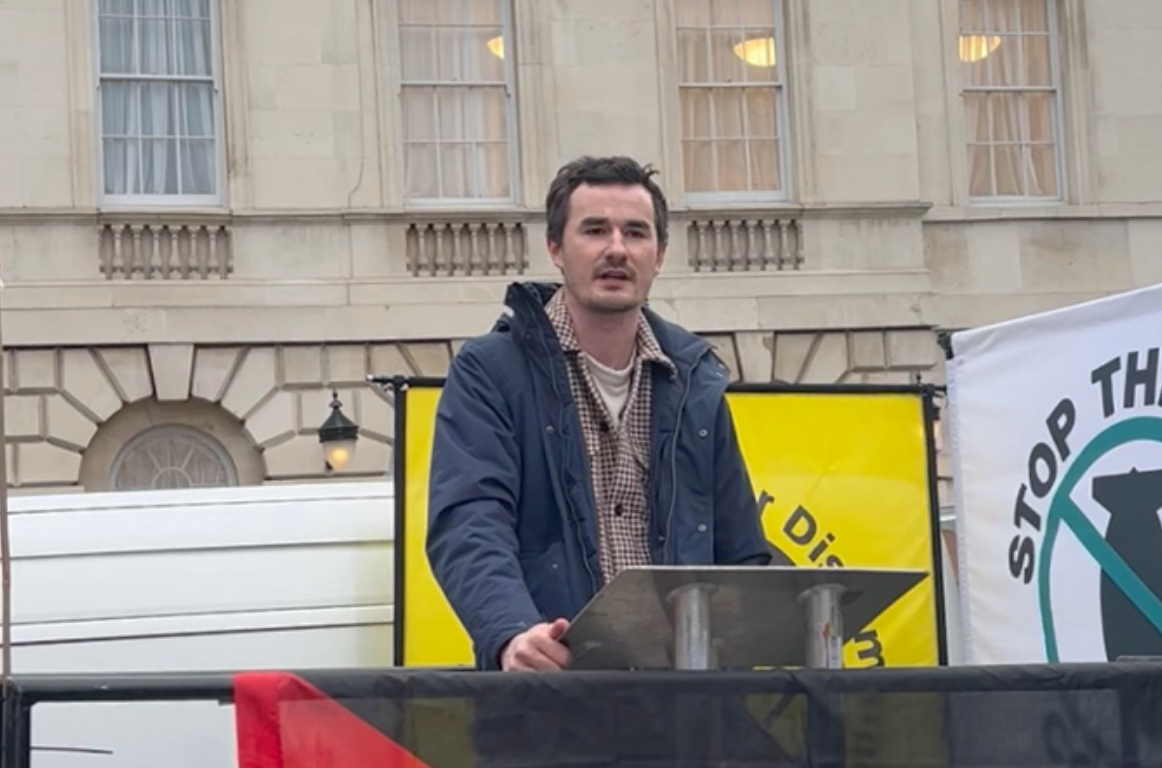
Republic lead march on Buckingham Palace calling for abolition of the monarchy
Over 300 campaigners joined Republic’s Republic Day march on 9 May, marching from Trafalgar Square to the gates of Buckingham Palace to call for abolition of the monarchy, with Graham Smith, Republic’s Chief Executive, noting a significant shift in public sentiment since the death of Queen Elizabeth II. Writer Otto English, speaking at the Trafalgar Square rally, drew a direct link between the local election results and a democracy “broken to such an extent that it needs fixing right to the top.” Demonstrations also took place in Edinburgh and at locations across the UK. View the photos of the London march.
Transparency International UK calls on incoming MSPs to strengthen Scotland’s lobbying register
Juliet Swann, Nations & Regions Programme Manager at Transparency International UK, says an early test for Scotland’s new parliamentarians will be whether they tighten the country’s lobbying transparency register, which she notes is a UK outlier simply by existing. Contributing to a Ferret investigation by Karin Goodwin that mapped more than 29,000 lobbying meetings over the last parliamentary term, Swann argues reporting should be extended beyond face-to-face communications and include some indication of financial outlay. Read the full Ferret investigation here.
Investigative journalist files complaint over Met Commissioner’s letter to Green Party leader
Investigative journalist Paul Holden has submitted a formal complaint to the Independent Office for Police Conduct over Sir Mark Rowley’s open letter criticising Green Party leader Zack Polanski, arguing the intervention violated the Met’s duty of political impartiality. Holden’s complaint states that the Commissioner “must know that during election periods it is anticipated that civil servants and other public officials will observe customary ‘purdah’ principles,” and that concerns could and should have been raised privately through existing London Assembly channels rather than made public.
APCO PR executive behind Labour Together journalist dossier leaves firm
Tom Harper, formerly APCO’s Head of Media Relations in Europe, has left the firm after audio emerged of him instructing a contractor to “get rid of” evidence of APCO’s work for the Labour Party aligned think tank Labour Together, despite a legal notice to preserve records. Harper authored a 58-page dossier alleging without evidence that journalists reporting on Labour Together’s undeclared funding were linked to a “pro-Kremlin network,” a scandal that previously prompted the resignation of cabinet minister Josh Simons. Read Peter Geoghegan’s full report at Democracy for Sale.
Byline Times investigation links Farage photograph to man convicted of church attack
Byline Times chief reporter Josiah Mortimer has published an eighteen-month investigation into a photograph showing Nigel Farage with members of Rushmoor People First, a Hampshire anti-migrant campaign group, taken in a private office setting in December 2024 and captioned online as a “Christmas drink” with Farage. One of the men pictured was convicted of assault by beating following the storming of an anti-racism meeting at Holy Trinity Church in Aldershot; another pictured, Jeremy Stocking, who was present at the church incident but not charged, was acting as a Reform UK election agent in Rushmoor during this month’s local elections. Reform UK has repeatedly declined to respond to requests for comment from the publication, Byline Times report.
SNP formally adopt cordon sanitaire against Reform UK at Holyrood
Following the Holyrood elections last week, in which Reform UK and Scottish Labour tied for second place with around 19 MSPs each, First Minister John Swinney has vowed to shun Reform MSPs from any cross-party workings or arrangements at Holyrood, in what amounts to a formal cordon sanitaire. Swinney has branded Reform “a threat to devolution,” and Nigel Farage has previously suggested the Scottish Parliament should be defunded.
Home Secretary bars at least seven people from UK ahead of Unite the Kingdom rally
The Home Secretary, Shabana Mahmood, has blocked at least seven people from entering the UK ahead of the Unite the Kingdom rally planned for London this weekend, including two American far-right figures: Valentina Gomez, an anti-Muslim influencer and Joey Mannarino. Prime Minister Keir Starmer described the event as “designed to confront and intimidate this diverse country” and signalled further bans were possible. Follow Searchlight for the latest news on far right activities and organising.
Christopher Collins says UK governance structures make accountability for public money almost impossible
Researcher Christopher Collins argues in a detailed investigation that a third of all government spending flows through hundreds of arm’s-length bodies that ministers cannot direct, Parliament cannot easily scrutinise, and voters cannot remove, creating the conditions for what he describes as legal corruption. Drawing on HS2 cost data, the Post Office Horizon scandal, the PPE Mone affair, and the revolving door between regulators and regulated industries, Collins notes that England has no criminal offence of negligent mismanagement of public funds, a reform recommended by the Committee on Standards in Public Life in 1997 and never enacted. Read the full investigation here.
Netpol call for testimony after PAVA spray used on antifascist counter-protesters during Manchester Britain First march
The Network for Police Monitoring, has issued a call-out for testimony from those present at a counter-protest in Manchester on 18 April, following reports that PAVA spray was deployed against counter-demonstrators during a march by far-right group Britain First. Up to 14 counter demonstrators were reported to have needed medical attention. Greater Manchester Police stated that PAVA was used after counter-protesters attempted to break police lines, while legal observers raised concerns about differential treatment between the two groups and the proportionality of the response.
Ahead of the protests, council leader Bev Craig and mayor Andy Burnham stated ‘there is no place in the city for any form of racism or hate’. Shaszur Ahmed, reporter for Portland News faced racist attacks whilst covering the march, “they were calling him an f****** immigrant and telling him to go home. It was really upsetting for him.” MPs have called for Britain First to be proscribed. Network for Police Monitoring are appealing for testimony of PAVA spray use.
Byline Times publish analysis of Palantir’s ‘anti-democratic’ manifesto
Catherine Menard, a tech executive with two decades in fraud detection, has written a decoding of the Palantir 22-point manifesto in Byline Times, summarising a book by CEO Alex Karp and legal counsel Nicholas Zamiska titled The Technological Republic: Hard Power, Soft Belief, and the Future of the West. Menard argues the manifesto openly frames democratic accountability as an obstacle to governance, calling for expanded authority for an unelected tech elite over defence and domestic policy. The piece lands as scrutiny of Palantir’s UK footprint intensifies, with contracts spanning the NHS, the MoD, the Met and now the FCA. Essential reading for anyone tracking big tech’s relationship with democratic infrastructure.
Capacity & Engagement
Building and strengthening a healthy democratic culture
Pull the Plug and PauseAI bring largest UK AI protest to date onto London’s streets
A new coalition of groups arguing for democratic oversight of AI platforms marched past the London offices of OpenAI, Meta, DeepMind and Google, in what amounts to the biggest AI protest yet held in the UK. The event marked the public debut of Pull the Plug, a UK campaign founded by former film story editor Harry Atkinson and Extinction Rebellion co-founder Frieda Lurken, which calls for legally binding Citizens’ Assemblies to regulate how AI is developed. Co-organised with PauseAI UK, the march brought together safety campaigners, ethics researchers, climate organisers and academics including Dr Rachael Kent of King’s College London, who used her speech to argue that “even tech monopolies are not above the law.” Joseph Miller, PauseAI UK director said that “what seemed like a tiny protest eight months ago was leading to this, and this will be tiny compared to what comes next.”
Civic Power Fund run authoritarian governance simulation for 80 social justice funders
Last month Civic Power Fund ran a bespoke simulation game, bringing together 80 UK social justice funders to explore how funding organisations might respond to an increasingly authoritarian UK government. Participants were challenged to navigate strategic trade-offs around a single central question: “faced with an authoritarian government, would your organisation resist or collaborate?” The game was designed and delivered by serious game design studio Stone Paper Scissors.
University of Westminster holds first UK university climate assembly
The University of Westminster Climate Assembly (UWCA) has released its full recommendations report, covering nine areas from interdisciplinary teaching and AI policy to ICT emissions, with 80% of recommendations receiving the support of assembly members. Sarah Allan and Anwen Alias were key to the delivery of the event, find out more about how the event worked.
Shared Future CIC mark Earth Day 2026 with showcase of citizen-led climate action
For Earth Day on 22 April, Shared Future CIC highlighted their work translating local climate assembly recommendations into citizen action, reflecting this year’s theme of community power. See their Earth Day post and project carousel on LinkedIn, documenting the projects their assembly participants have gone on to catalyse across the country.
Safe Landing puts Workers’ and Civic Assemblies at the heart of Green Party aviation motion
Safe Landing, the community of aviation workers campaigning for a sustainable industry transition, is proposing Workers’ and Civic Assemblies as the mechanism for engaging both aviation workers and airport-adjacent communities in shaping the future of UK aviation. George Hibberd, former easyJet pilot and Safe Landing co-founder, is lead author of the policy, which will go before the Green Party’s Transport Policy Working Group as a motion at the autumn conference.
Evens Foundation fund new bridge between WhatsApp and Decidim
The Evens Foundation have committed €10,000 to civic tech outfit Octree to build and open-source a bridge connecting WhatsApp users directly to the widely used Decidim participation platform. Matt Stempeck, the new Director of Technology & Democracy at the Evens Foundation, sets out a “deceptively straightforward” two-step strategy: go where people already are online, then bridge that organic engagement back to democratic institutions, rather than building new destination sites few will visit. Read the full piece on LinkedIn.
BBC plans up to 2,000 job cuts in biggest downsizing in 15 years, with newsroom bearing the steepest reduction
The BBC is set to cut as many as 2,000 jobs, around 10% of its 21,500 staff, as part of a £600m savings drive over the next three years. BBC News, home to roughly a quarter of the workforce, has been told to expect a 15% cut, above the corporation-wide 10% average. Culture Secretary Lisa Nandy told MPs the cuts have had a “very, very strong effect” on staff and are “of real concern to people out in the country”, with affected staff not expected to learn their fate until September. Private Eye journalist Ian Hislop highlighted the fate of the BBC World Service amidst the cuts, saying “we’ve got aircraft carriers that don’t work. We’ve got a soft power radio station that works unbelievably well, and we’re going to cut that?”
Migrant Voice launch new cohort of London Ambassadors Programme
Migrant Voice began a new round of its London Ambassadors Programme on 18 April, training community members to get migration stories into the media, craft impactful messages and challenge negative stereotypes in public discourse. The programme covers skills including pitching, interviewing and navigating today’s media landscape, and runs until 13 June.
The Economist features Vote Confident research on preparing young people to vote at 16
With 16-year-olds set to receive the vote under the Representation of the People Bill, The Economist has featured research from the Vote Confident programme exploring how schools can better prepare young people for democratic participation. The piece arrives as civic education capacity across UK schools remains patchy and uneven. Read the Economist piece here (paywall).
National Strategy Project co-founder makes case for deliberative democracy technology in the Financial Times
Catherine Day, co-founder of the National Strategy Project and former senior UK Cabinet Office official, has written to the Financial Times arguing that combining technology with deliberative democracy offers far more than improved voting mechanisms, giving millions of people a real voice in complex decisions and helping countries “face reality, make choices and follow through.” Day, who grew up in Northern Ireland during the Troubles, writes that our current system captures political preferences but fails to enable long-term collective decision-making, describing this as “a fatal weakness at the heart of our democracy.” Read the letter here (FT subscription required).
And now for something completely different …
A glance beyond the UK sector

Sudan Digital Archive works to preserve and remember a free Sudan
The Sudan Digital Archive, a new project developed by Asil Sidahmed and others currently incubated by Newspeak House, is working to preserve the democratic culture of the people of Sudan amidst a devastating genocide and civil war. The digital archive is working to preserve song, community artifacts, messages of support, snippets of memory from the democratic revolution and the transitional government, before its overthrow by Sudanese armed groups. The archive will also securely host public evidence of war crimes for consideration by international courts.
Remembering Sudanese revolutionary Muzan Alneel
Amidst the ongoing mass atrocities and genocide in Sudan, the Transnational Institute and the Middle East Research and Information Project have published moving obituaries for Muzan Alneel, the Sudanese writer, researcher and revolutionary organiser who died on 15 April aged 39, on the third anniversary of the outbreak of Sudan’s counterrevolutionary war. A co-founder of the Khartoum-based think tank ISTiNAD and a fellow at TNI and the Tahrir Institute for Middle East Policy, Alneel built a body of work that placed people, rather than states or development models, at the centre of democratic transformation. Read the moving tributes on MERIP and TNI.
Copenhagen Democracy Summit convenes global leaders today around defence of democracy in a new world order
The Alliance of Democracies Foundation’s annual Copenhagen Democracy Summit takes place this week, at the Royal Danish Playhouse, with the theme “Building an Alliance of Democracies in a New World (dis)Order.” Speakers include Mette Frederiksen, Acting Prime Minister of Denmark, Chrystia Freeland, former Deputy Prime Minister of Canada, Yoshua Bengio of LawZero, Masih Alinejad, and Taiwan’s President Lai Ching-Te joining virtually, alongside democracy activists and civil society voices from Ukraine, Uganda and Iran. View the full agenda and speakers.
Newspeak House host emergency “RightsCon in exile” unconference after China pressure forces cancellation of global digital rights summit
This month Zambia cancelled RightsCon 2026 just days before it was due start. Chinese diplomatic pressure over the participation of Taiwanese civil society delegates drove the decision, a move condemned by Amnesty International, Human Rights Watch and the UN Special Rapporteur on freedom of assembly as transnational repression. Newspeak House in London stepped in to host an emergency replacement unconference, with Newspeak House fellows and students Anouk Ruhaak, Asil Sidahmed and Fatima Sarah Khalid pulling together sessions at short notice; Anouk Ruhaak, Chair of the Netherlands Data Protection Foundation, said the cancellation had “sparked many reflections on how spaces for meaningful human rights advocacy are shrinking” and that turnout at the replacement event had helped “lift some of the despair.”
See you next time,
James and the Democracy Network team